|
|




|
|
News The Project Technology RoboSpatium Contribute Subject index Download Responses Games Gadgets Contact <<< Extruder V7.1 Syringe extruder >>> Properties of plastic powder and Direct granules extruder V7.2The video about Direct Granules Extruder V7.2.Design of Extruder V7.2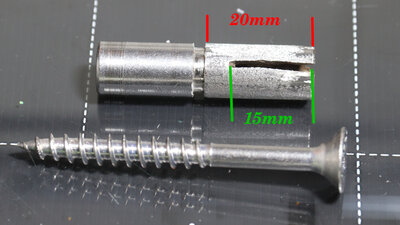
For the print tests in this chapter, I used version 7.2; the only difference between this and the previous version (V7.1) is a slot cut into the top section of the threaded connector - approximately 1 mm wide and 15 mm long. This slot is covered by the water-cooling aluminum block, leaving a groove that acts as a radial brake, thereby improving extrusion. The constriction is located 20 mm from the top edge. It is 1-2 mm wide and deep enough to leave a remaining diameter of 8 to 8.5 mm. The suface of the upper section is roughened - a feature that has proven advantageous in practice, given that the extruder tube is merely clamped to the water-cooling aluminum block using two screws. A standard wood screw - with a thread diameter of 6 mm and a core diameter of 3.7 mm - continues to serve as the extruder auger. The internal thread of the M6 stainless steel sleeve is removed using a 6.8 mm drill bit, and the resulting bore is then enlarged to a diameter of 7 mm using a hand or machine reamer. The reamer ensures a smoother bore wall. At the top edge, the bore is drilled out to a diameter of 8 mm to a depth of 6-8 mm. While the extruder will technically function without this stepped bore, this modification at the top edge increases material feed per screw rotation by up to 20%. Using two or more stepped bores spaced 3-4 mm apart also works, though the improvement in extrusion rate is relatively minor - at least with PLA powder. Results might differ with other materials. 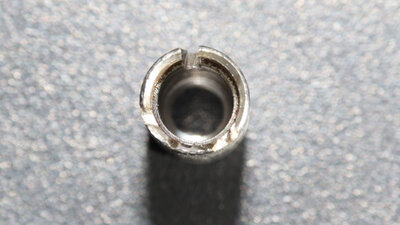
At the top edge, the threaded sleeve is widened using a 90° countersink to a diameter almost equal to the outer diameter. Two additional notches at the top edge improve material feed. 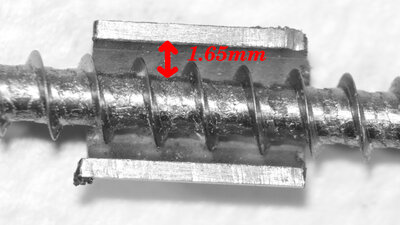
This leaves a maximum gap of 1.65 mm between the extruder wall and the screw core for a 7 mm bore. Consequently, the raw material to be printed must have a smaller particle size. All other components remain unchanged compared to the predecessor version V7.0. Rawmaterial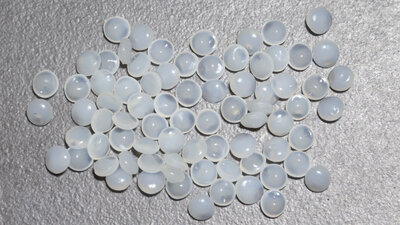
Shown here is industrial granulate; with a size of 3-5 mm, it does not fit into my extruder and therefore cannot be printed directly: The granules have an irregular shape, lacking sharp corners or edges. They are produced by forcing molten plastic through a perforated plate and scraping it off with a sharp blade immediately behind the plate while the material has not yet fully cooled. The sharp cut edge flows back together before the plastic solidifies, resulting in the lens-like particles seen here. 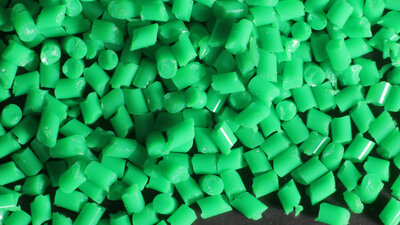
The pellets are cylindrical, with a diameter of 1.5 mm and a length of up to 2 mm. They are produced by chopping 1.5 mm diameter filament in a cold state. Consequently, the cut edges are sharp. 
Shown here is powder made from PLA waste using a modified grain mill. This is an old batch I produced over a year ago; I now use a slightly finer sieve. The sieve had 1.6 mm holes, resulting in noticeably larger granules in the mix compared to industrial powder. The granules are multicolored because I hadn't sorted the PLA by color. 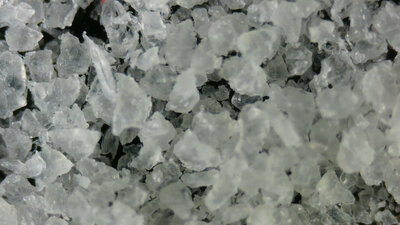
The industrial granulate consists of very small, sharp-edged, irregularly shaped particles, indicating that the material was produced by mechanically crushing larger particles. The particle size is specified as 0.4 mm, but the size is not uniform; many grains are visible that are significantly smaller than the specified 400 micrometers. Following the crushing process, the material is sieved, and the specified size refers to the mesh size of the sieve used. The particles are transparent; no colorants have been added to the PLA. Density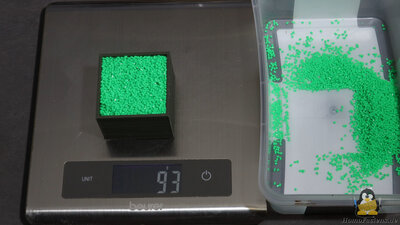
To determine the average density, a container with a volume of 5×5×4cm = 100cm3 was filled, and its weight was determined. The following values were obtained: Granules: 0.69g/cm3 Pellets: 0.66g/cm3 Recycled powder: 0.55g/cm3 Industrial powder: 0.51g/cm3 Compressibility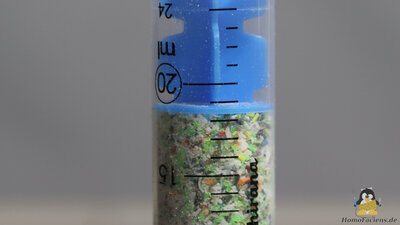
In this experiment, the materials were loaded into a 20 ml syringe, and light hammer blows were subsequently applied to the plunger. The granules and pellets could be compacted only negligibly, and the material subsequently trickled out of the syringe easily. The volume of the recycled powder could be reduced by 1.5 ml, while that of the industrial powder was reduced by slightly more than 2 ml. These two materials trickled out of the syringe only after light tapping. Demixing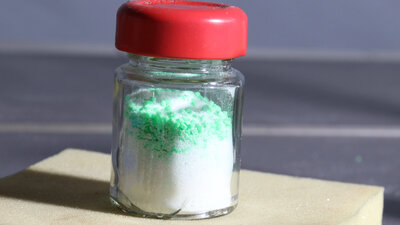
Here, I have filled a glass with a mixture of the industrial powder and the green pellets. The glass was shaken for a few seconds to simulate the movement of the print head and with the hopper. You can see the large green pellets moving to the top, while the powder settles toward the bottom. The fill consistency is no longer uniform; since the material feed into the extruder depends on this, such segregation of the raw material must be prevented. Infill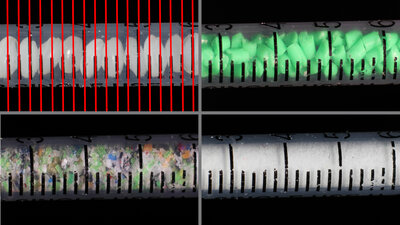
Here, I loaded the materials into a syringe with an inner diameter of 4.5 mm. An examination of the partial volumes reveals the formation of voids of varying sizes within the tube. The resulting statistical fluctuations in the extrusion rate are lower, the smaller the material's particle size. I subsequently fed the powders using a stepper motor and the syringe plunger. This process demonstrated that the powders moved the most uniformly. The greatest fluctuations occurred with the pellets; the sharp edges of the cut surfaces snagged on the syringe wall, intermittently blocking movement. Entering the extruder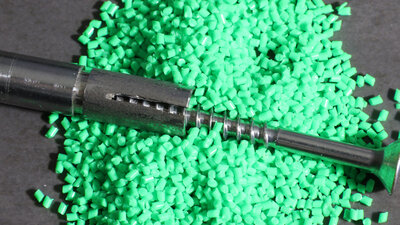
The feed into the extruder also exhibits lower statistical fluctuations the smaller the raw material granules are: If only a single pellet fits between the screw and the extruder wall, it is crucial whether the screw can grip it immediately or whether it first travels a few millimeters along the top edge of the barrel. With powder, the movement of an individual particle is less significant; consequently, statistical fluctuations during material intake are lower. Flowability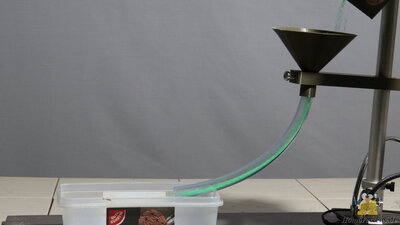
Granules and pellets are optimized for material transport to the extruder. They possess excellent flowability, allowing them to be easily fed from storage containers through hoppers and tubes. The sharp-edged grains of powders exhibit higher friction-both among themselves and against the walls of the material feed system. Another drawback of powder is its fine, dust-like component, which clings to surfaces due to electrostatic forces and is easily dispersed by the slightest draft. Therefore, special safety precautions must be observed when handling powders-wearing a dust mask is just one of them. Plastic granules are often coated to reduce abrasion during transport and, consequently, dust formation. In the experiment, the granules and pellets flow downward without issue, whereas the powders clog the hose. The pellets also spill out easily when emptying the printer's storage container. In contrast, it is significantly more difficult to completely remove the powder before a material change. Relative size matters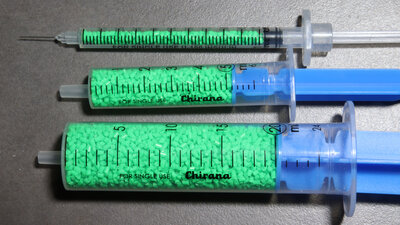
The particle size relative to the extruder size determines the statistical fluctuations in material feed. With a large extruder, the pellets are relatively small, and fluctuations in the extrusion rate have less impact given the high volumetric throughput. Extruders that use pellets as raw material are designed for printing large structures, not for fine details. DownloadThe 3D files and the extruder sketch are available as a download package.Testprints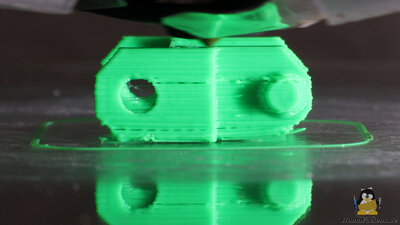
Track link Pellets Dimensions: 27x25x12mm Layer height: 0.2mm Extrusion width: 0.5mm Print speed: 30 und 80mm/s While extrusion using the pellets is technically feasible, the process is far from uniform. In addition to the previously mentioned pellet size relative to the extruder volume, another material property is responsible for the poor print quality: To print with the pellets, I had to increase the filament factor - which determines the amount of plastic extruded per screw rotation - to three times the value used for the recycled powder. Given the density difference, a reduction would have been expected. Evidently, the extruder transports the pellets with significant slippage. The smooth pellet surfaces that ensure good flowability cause the material to rotate along with the screw, as the extruder wall provides insufficient radial resistance to hold it in place. This also hinders the material's entry into the extruder. Gaps visible on the walls of the chain link indicate severe underextrusion, while clearly protruding layers in other areas point to overextrusion. 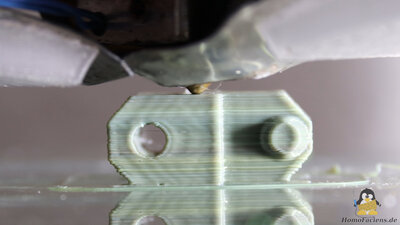
Track link recycled powder Dimensions: 27x25x12mm Layer height: 0.2mm Extrusion width: 0.5mm Print speed: 30 und 80mm/s I have demonstrated this test print several times using recycled PLA. The printed object clearly shows, along its straight walls and edges, just how consistently the material is extruded. The result is good; however, some layers protrude slightly, indicating that the extrusion is subject to minor fluctuations. 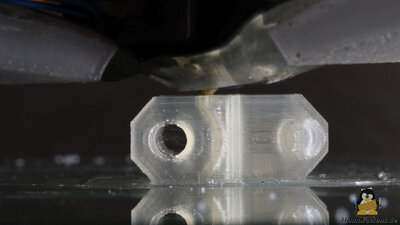
Track link industrial powder Dimensions: 27x25x12mm Layer height: 0.2mm Extrusion width: 0.5mm Print speed: 30 und 80mm/s The industrial powder is printed using the same parameters; only the filament factor was adjusted. This had to be set to 140% relative to the recycled powder. Based on the difference in density, a value of only 108% would have been expected. Evidently, the distinct flow behavior of the very fine granules is the decisive factor here. The gap between the screw and the extruder wall is necessary to allow air trapped in the powder to escape upwards. If this gap is wide and the material being processed is very fine-grained, slippage occurs between the screw and the extruder wall as the powder is pressed downwards. A narrower gap should ensure better material transport. However, the slippage does not vary while the material is being transported toward the nozzle - after all, the experiment showed that the fine powder was forced through the tube very uniformly. Consequently, the extrusion process can be precisely controlled, yielding the best print result of the entire test series. The transparent PLA shows no gaps - neither in the outer walls nor in the internal structures - and contains only a very small number of tiny air bubbles. 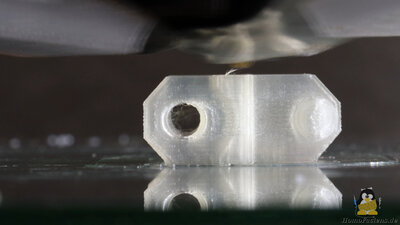
Track link industral powder Dimensions: 27x25x12mm Layer height: 0.1mm Extrusion width: 0.5mm Print speed: 30 und 80mm/s Encouraged by the excellent print result, I halved the layer height to 0.1 mm for the subsequent test, keeping all other parameters identical. The extruder now has to precisely dispense even smaller volumes of molten plastic. This, too, works very well. <<< Extruder V7.1 Syringe extruder >>> News The Project Technology RoboSpatium Contribute Subject index Archives Download Responses Games Links Gadgets Contact Imprint |

|